A Day at Covadonga: History, Miracles & Mountain Lakes, 15 Minutes from Casa Llenín
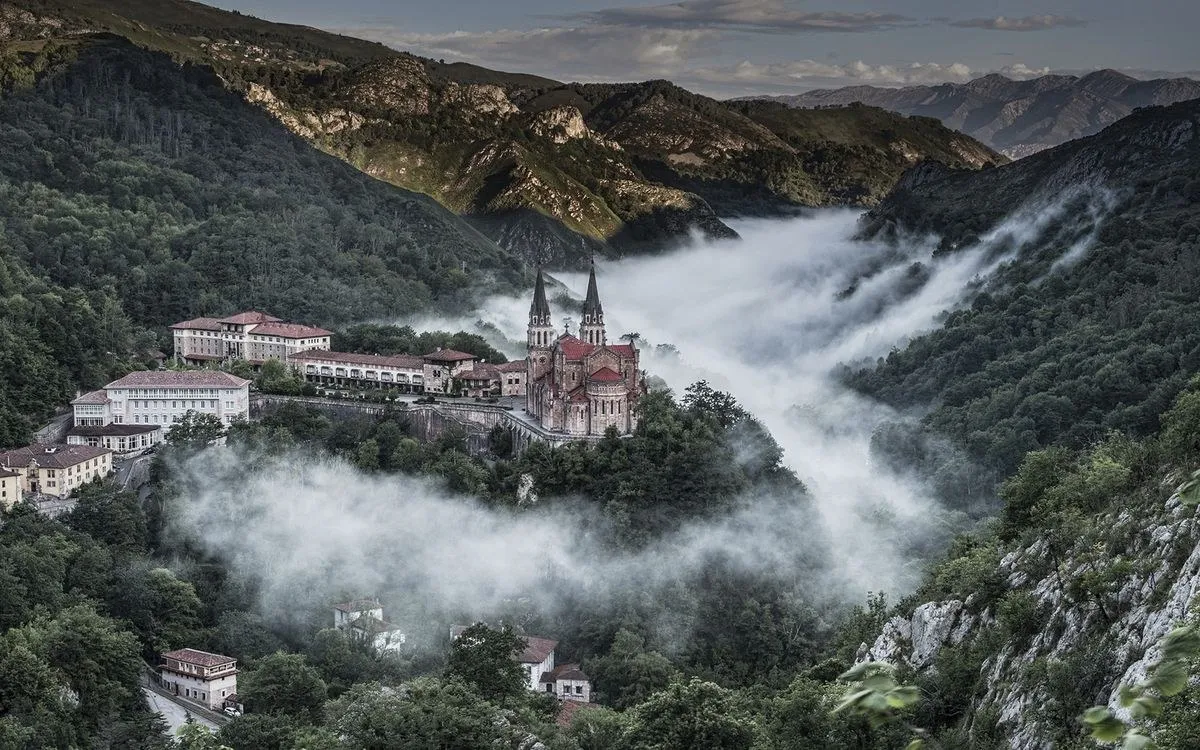
Some places carry the weight of centuries in every stone. Covadonga is one of them. Tucked into a limestone gorge at the edge of the Picos de Europa, it is where the story of Christian Spain is said to have begun. In 722 a Visigothic nobleman named Pelayo led a few hundred men against a far larger Moorish army, and won. That improbable victory founded the Kingdom of Asturias and opened the long chapter of history known as the Reconquista.
From Casa Llenín it is fourteen kilometres. You can be standing in front of the basilica before your coffee has worn off.
The basilica and the Holy Cave
The Basilica of Santa María la Real rises from a spur of rock in pale pink limestone, its twin spires set against oak forest and whatever the clouds are doing that morning. It was built between 1877 and 1901, it is free to enter, and it is handsome from every angle. The view back down the valley from the esplanade is reason enough to come.
A path leads on to La Santa Cueva, a natural cave in the cliff face with a waterfall dropping from beneath it. Inside is La Santina, the Virgin of Covadonga, a small and richly dressed figure who has been the focus of Asturian devotion for more than a thousand years. Pelayo’s tomb is here too. People speak quietly without being asked.
Below the cave, water runs from the rock at the Fuente de los Siete Caños, the fountain of seven spouts. Local legend says that a young woman who drinks from all seven without drawing breath will marry within the year. Worth a try, or worth avoiding, depending.
Up to the lakes
Twelve kilometres above the sanctuary, at over a thousand metres, lie the Lagos de Covadonga: Enol and Ercina, two glacial lakes in open pasture beneath the western massif of the Picos. Cattle graze the shore. On a still morning the peaks sit upside down in the water.
An easy circular walk of about 6.5 km joins the two lakes. Allow two hours and ordinary fitness. Go early: the light is better, the crowds are thinner, and cloud tends to roll in during the afternoon.
The road is closed to cars on most days
This is the part guests wish they had known. The road from Covadonga up to the lakes is now closed to private cars for most of the year, not only in August. People arrive expecting to drive up and are turned round at the barrier.
| Period in 2026 | Private cars |
|---|---|
| 1 June to 18 October | Closed |
| Weekends in May, and 1 May | Closed |
| Late March and much of April | Closed on many dates |
| 24, 25 and 31 October; 1 and 2 November | Closed |
| 1 to 8 December | Closed |
| The rest of the year | Open |
On closed days you go up by ALSA bus. Book online before you travel: online bookings take priority, and in high season the tickets sold at the car parks often run out. In 2026 an adult return costs €9 and a child of 4 to 11 pays €3.50. Buses leave from five car parks between Cangas de Onís and Covadonga, starting at 08:00, and parking is €3 a day. Your ticket also covers the shuttle to the sanctuary.
Bicycles are always allowed. A restaurant booking at the top does not get your car through the barrier, whatever you may have read. If you miss the last bus, shared taxis run from Covadonga until early evening.
The dates are reviewed every year. Check them before you set off; the tourist office in Cangas de Onís posts the current calendar, and so do we, in the house.
Practical tips
- Timing: be at the sanctuary by nine. By mid-morning in summer the coaches have arrived.
- A full day: sanctuary first, then the bus to the lakes, the circular walk, and a late lunch back in Cangas de Onís.
- What to wear: a layer and a waterproof, even in July. The lakes are 1,100 metres up and the weather turns in twenty minutes.
- Dogs: on a lead throughout the national park. The buses carry them free in the luggage bay.
The best thing about staying fifteen minutes away is that you do not have to do Covadonga the way everyone else does. Go at eight, when the cave is empty and the mist is still in the valley. Be back on the terrace at Casa Llenín for lunch, with Peña Santa on the horizon and the lakes you have just walked round somewhere at its foot.